
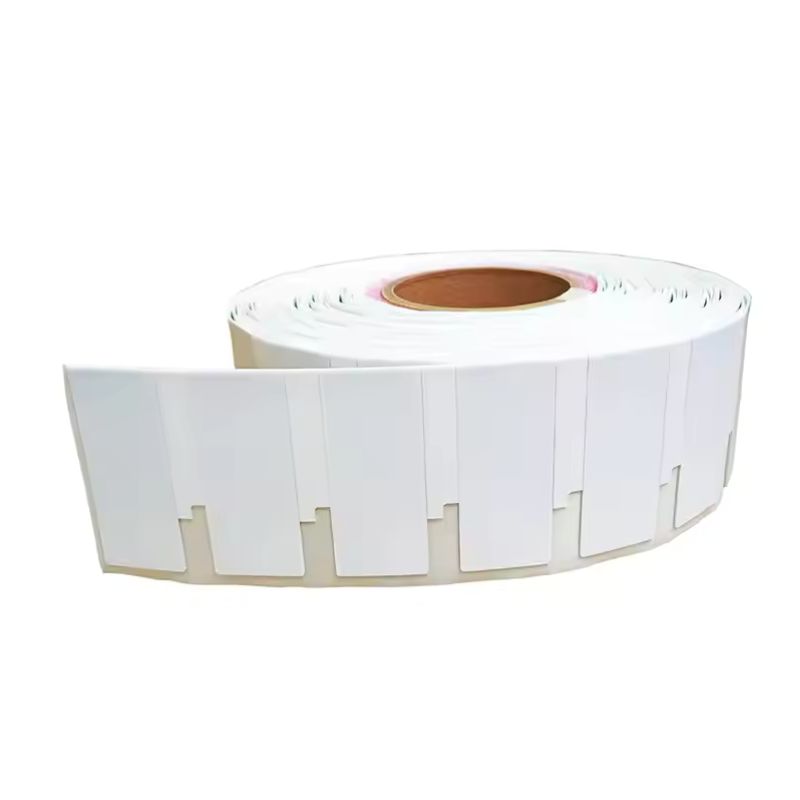


UHF Printable Flexible RFID Smart Label On-metal Sticker
Printable UHF Anti Metal RFID Tag for Asset Tracking
A flexible RFID tag is a bendable UHF RFID label used when a hard RFID tag is too thick, heavy, or difficult to install.
This label uses an RF isolation layer to support RFID reading on metal assets. It is suitable for flat or moderately curved surfaces, depending on label size, adhesive type, and installation conditions.
The tag operates at UHF 860–960 MHz and is designed for asset identification workflows that need both RFID data and printed information such as barcodes, QR codes, or serial numbers.
Flexible RFID Tag Key Product Features
- Flexible Label Structure
The bendable format helps the tag fit surfaces where standard hard tags may not be practical. - Printable Surface
The label can support thermal transfer printing for visible asset information, including text, barcode, QR code, and numbering. - UHF RFID Reading
UHF technology enables contactless identification with compatible RFID readers, reducing the need for barcode-only line-of-sight scanning. - Adhesive Installation
Industrial adhesive backing allows direct mounting without screws or mechanical fixtures. - On-Metal RFID Design
The RF isolation layer helps maintain RFID readability when the label is applied to metal assets.
Flexible RFID Tag Technical Specifications
| Feature | Specification |
| Product Type | Flexible RFID tag / UHF on-metal RFID label |
| Main Application | RFID tags for metal surfaces and industrial asset tracking |
| Frequency | UHF 860–960 MHz |
| Protocol | EPC Gen2 / ISO 18000-6C, depending on chip selection |
| Read Range | Up to 6 m, depending on reader, antenna, surface, and environment |
| Surface Compatibility | Flat metal and selected curved metal surfaces |
| Material Structure | Printable label face, RF isolation layer, adhesive backing |
| Mounting Method | Industrial adhesive |
| Print Method | Thermal transfer printing |
| Encoding Options | EPC encoding, sequential numbering, asset ID matching |
| Customization Options | Size, chip, adhesive, printing, encoding, logo, barcode, QR code, packaging |
| MOQ | 500 pcs |
Flexible RFID Tag Typical Applications
- Manufacturing Assets
Used for equipment, fixtures, work-in-progress items, and reusable production assets. - IT and Data Center Equipment
Applied to servers, racks, storage devices, cabinets, and network equipment for asset audits. - Logistics Containers
Used on bins, cages, pallets, containers, and returnable transport items. - Automotive and Aerospace Parts
Supports identification of parts, assemblies, and components. - Tool Management
Used in tool rooms to connect tools and equipment with check-in/check-out records.
Flexible RFID Tag vs Standard RFID Label vs Hard UHF RFID On-Metal Tag
| Comparison Point | Standard RFID Label | Flexible RFID Tag for Metal Surfaces | Hard UHF RFID On-Metal Tag |
| Use on metal | Usually not suitable directly on metal | Designed with RF isolation layer | Designed for on-metal use |
| Surface fit | Best for flat non-metal surfaces | Fits flat and selected curved surfaces | Best for fixed mounting points |
| Read performance | Good away from metal; weaker on metal | More stable than standard labels on metal | Usually strongest on-metal option |
| Read distance | Strong on non-metal assets; reduced on metal | Up to 6 m | Often longer, depending on tag design |
| Thickness | Thin | Thin to medium | Usually thicker and rigid |
| Printing | Usually printable | Thermal transfer printable | Limited printable area |
| Mounting method | Adhesive | Industrial adhesive | Adhesive, screw, rivet, or cable tie |
| Best use cases | Cartons, plastic assets, documents, packaging | IT assets, bins, curved surfaces, containers, tools | Outdoor equipment, machinery, pallets, heavy-duty assets |
| Cost level | Usually lower | Medium | Usually higher |
A standard RFID label is suitable for cartons, plastic assets, documents, and packaging, but may not read reliably when attached directly to metal.
A flexible RFID tag is a better option when the asset requires a printable, adhesive-backed label with on-metal readability and a low-profile format.
A hard UHF RFID on-metal tag is usually selected for heavy-duty environments where stronger mechanical protection, screw mounting, or longer read distance is required.
Need a Flexible RFID Tag for Your Metal Asset Project?
Share your asset surface, label size, reader model, print file, encoding format, adhesive requirement, and operating environment.
JIA RFID can review these details and recommend a flexible on-metal RFID label configuration suitable for your application before bulk production.
Frequently Asked Question
The top questions about Flexible RFID tag.
A flexible RFID tag is a bendable RFID label used where a rigid tag may not be suitable.
Yes. It uses an RF isolation layer to support on-metal RFID reading.
Yes. It is an anti metal RFID tag designed to reduce metal interference during RFID reading.
Yes. It supports thermal transfer printing when used with compatible printer and ribbon materials.
The read range can reach up to 6 meters, depending on the RFID system and installation environment.
Yes, on selected curved surfaces. Suitability depends on tag size, bend radius, adhesive type, and surface condition.
The MOQ is 500 pcs.
Recommended details include asset material, surface shape, reader model, label size, print file, encoding format, adhesive requirement, operating environment, and quantity.
Related Products
Customize any types RFID tags from our factory to meet your own requirements.