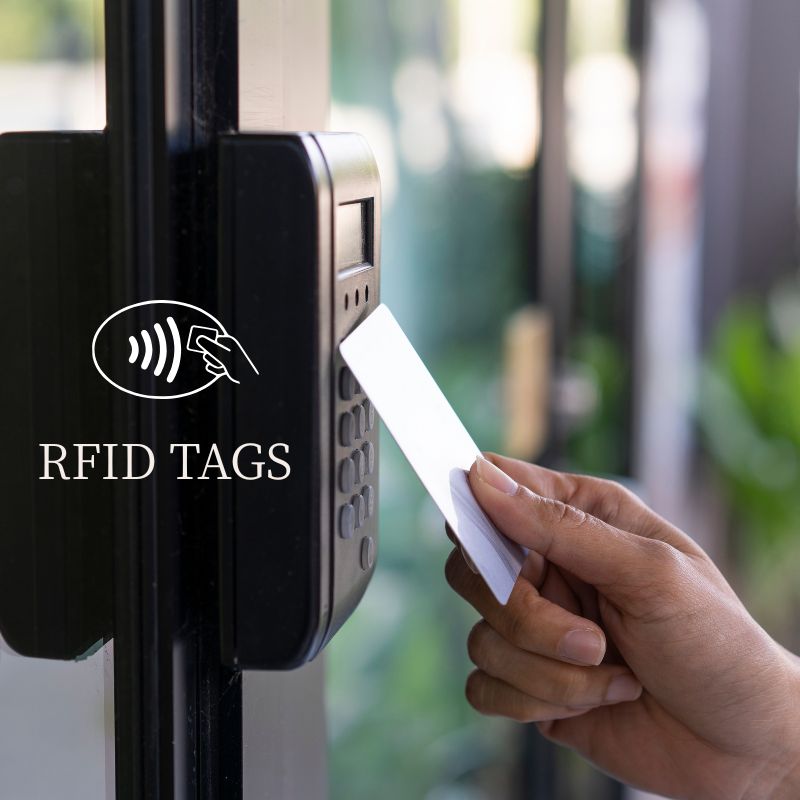
Low Frequency RFID and High Frequency RFID are both inductive RFID technologies that rely on magnetic field coupling between the reader and the tag. Despite this shared operating principle, they run at very different frequencies, which leads to major differences in performance, hardware design, and application focus.
Because of this similarity in the coupling method, LF and HF are often grouped together or assumed to be interchangeable. In practice, they are built for different operating conditions. Differences in frequency affect antenna size, read distance, data speed, memory structure, environmental stability, and security capability. Selecting the wrong frequency can lead to unstable reads, limited scalability, or unnecessary system cost.
This guide explains the technical differences between Low Frequency and High Frequency RFID in detail, so you can determine which option fits your specific use case.
Low Frequency RFID vs. High Frequency RFID
| Difference | Low Frequency RFID (125 kHz / 134.2 kHz) | High Frequency RFID (13.56 MHz) | Practical Impact |
| Frequency range | Typically 125 kHz or 134.2 kHz | Standardized at 13.56 MHz | Determines antenna size, signal behavior, and communication speed |
| Coupling type | Near-field inductive coupling | Near-field inductive coupling | Both rely on magnetic field coupling between the reader and the tag |
| Typical read range | About 2–10 cm for small tags; up to ~30 cm with large antennas | About 3–10 cm for proximity cards; 20–50 cm is common for ISO 15693 systems; up to ~70 cm in optimized setups | HF can achieve a slightly longer range in tuned systems |
| Anti-collision capability | Usually limited; many systems read one tag at a time | Built-in anti-collision in ISO 14443 and ISO 15693 | HF systems handle multiple tags more reliably |
| Data rate | Typically around 2–8 kbps, depending on modulation and system design | ISO 14443 supports 106–848 kbps; ISO 15693 typically ~26–53 kbps | HF supports faster communication and shorter transaction times |
| Typical memory capacity | Often read-only ID; typically 32–128 bits; limited user memory on some tags | From a few hundred bytes to several kilobytes, depending on chip type | HF supports larger on-tag data storage |
| Write capability | Many tags are read-only or write-once; limited rewriting | Most tags support read-write operations with many rewrite cycles | HF is better for applications requiring data updates |
| Standards and protocols | ISO 11784 / ISO 11785 are mainly for animal ID; many proprietary 125 kHz systems | ISO 14443, ISO 15693, ISO 18092 (NFC) | HF ecosystems support stronger interoperability |
| Antenna design | Larger multi-turn coil antennas, often with ferrite cores | Flat spiral antennas etched or printed on substrates | HF allows thinner tag designs |
| Tag formats | Glass capsules, ear tags, immobilizer transponders, rugged tokens | Smart cards, labels, NFC stickers, tickets, inlays | HF supports more compact and flexible tag forms |
| Water and tissue tolerance | Generally strong due to lower frequency | Moderately affected by water and high moisture | LF performs better in biological environments |
| Metal sensitivity | Can detune near metal but generally less sensitive than HF | More sensitive to metal without shielding or spacing | HF deployments near metal often require special tag design |
| Reader complexity | Typically simpler reader electronics and protocols | More complex reader chipsets supporting multiple protocols and security features | HF readers may require more configuration |
| Best-fit applications | Animal ID, pet microchips, vehicle immobilizers, simple access control | Access cards, library systems, transit tickets, contactless payment, NFC interactions | Application choice depends on data needs and reading environment |
1. Frequency Range
One of the most direct differences between Low Frequency RFID and High Frequency RFID is the operating frequency of the carrier signal.
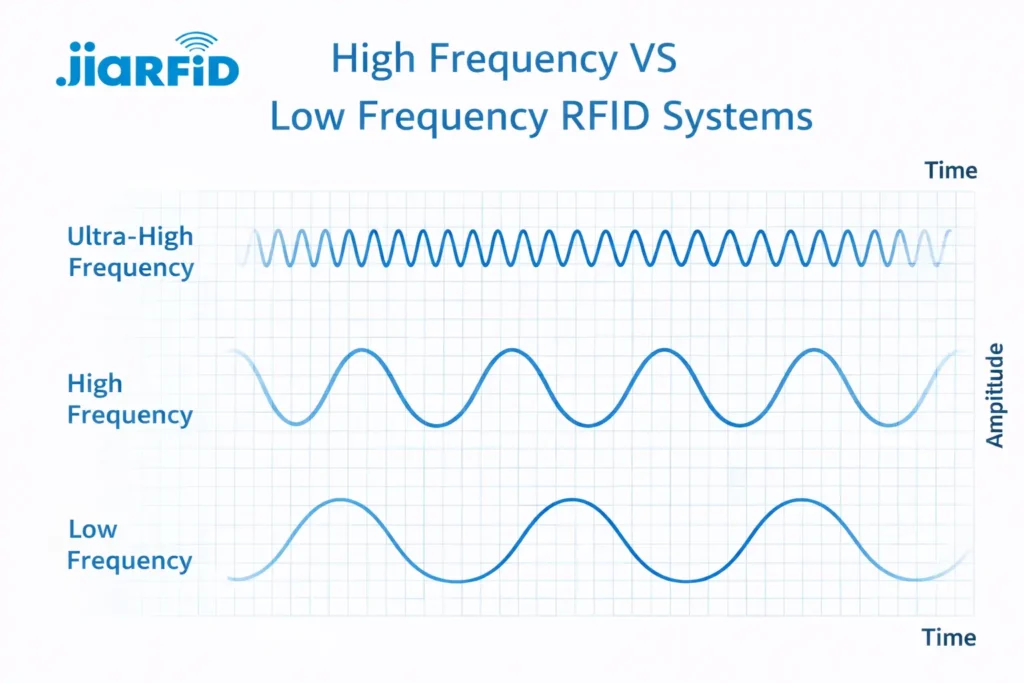
Low Frequency RFID typically operates at 125 kHz or 134.2 kHz. While the broader LF spectrum spans roughly 30 kHz to 300 kHz, commercial LF RFID systems are standardized around these two values, especially 134.2 kHz under ISO 11784 and ISO 11785 for animal identification.
High Frequency RFID belongs to the 3 MHz to 30 MHz spectrum range. In practice, however, almost all HF RFID systems operate specifically at 13.56 MHz, which is an internationally standardized frequency band. NFC, ISO 14443, and ISO 15693 systems all use 13.56 MHz globally.
In summary:
• Low Frequency RFID: 125 kHz or 134.2 kHz (within 30–300 kHz band)
• High Frequency RFID: 13.56 MHz (within 3–30 MHz band)
Although both are short-range inductive systems, the operating frequency differs by roughly a factor of 100, forming the basis for further technical differences.
2. Communication Method
Another fundamental difference between Low Frequency RFID and High Frequency RFID lies in how the reader and tag communicate through magnetic coupling.
Low Frequency RFID systems use inductive coupling in the near-field region. The reader generates a low-frequency magnetic field, and the tag is powered when it enters this field. Data transmission typically relies on simple load modulation techniques such as amplitude shift keying or frequency shift keying. Many LF systems use fixed-format communication structures, such as FDX-B or HDX, designed primarily for stable identification rather than complex command exchange.
High Frequency RFID systems also use inductive coupling, but the communication layer is more structured. At 13.56 MHz, data exchange is defined by standardized protocols such as ISO 14443 and ISO 15693. Communication includes defined modulation depth, framing, timing requirements, and anti-collision procedures. HF tags respond to reader commands through load modulation combined with subcarrier techniques, enabling controlled command-response interaction.
While both LF and HF rely on magnetic field coupling, LF communication is typically simpler and ID-focused, whereas HF communication follows standardized protocol layers that support structured interaction between reader and tag.
These differences in communication structure also influence how far a tag can be reliably read.
3. Typical Read Range
Read distance is one of the most practical differences between LF and HF RFID systems.
Low Frequency RFID is designed for very short range identification. For example, passive LF tags are read within a distance of about 2 to 10 centimeters when using small tags such as glass capsules or keyfobs. With larger reader antennas and optimized setups, the read range can extend to around 20 to 30 centimeters, but it rarely goes beyond that. LF systems rely on strong magnetic coupling between the reader coil and the tag coil, and this magnetic field drops off quickly as distance increases. Therefore, LF technology is inherently limited to close proximity reading.
Compared to LF RFID, High Frequency RFID generally achieves a slightly longer practical read range. In common applications such as access control cards and NFC systems, the read distance is usually around 3 to 10 centimeters. However, with larger loop antennas and ISO 15693 compliant systems, HF tags can often be read at distances between 20 and 50 centimeters, and in carefully tuned industrial systems, the range may approach 60 to 70 centimeters.
4. Environmental Sensitivity
When it comes to environmental conditions, Low Frequency RFID is generally more stable in challenging environments, especially around water and metal. Because LF operates at a much lower frequency, the magnetic field it generates is less affected by high moisture content and conductive materials. In livestock applications, for example, LF ear tags continue to perform reliably even when the tag is surrounded by body tissue, which contains a high percentage of water. The lower frequency interacts more predictably with water-rich materials and is less prone to detuning from nearby metal.
High Frequency RFID is moderately more sensitive to environmental conditions. While HF also uses magnetic coupling, its higher operating frequency makes it more affected by conductive materials and moisture. Water can absorb part of the electromagnetic energy at 13.56 MHz, which may reduce read stability when tags are placed directly on liquid containers or near the human body. Metal surfaces can also detune HF antennas more easily, especially when tags are mounted directly on bare metal without insulation. However, in controlled indoor environments such as access control, libraries, and NFC payment systems, HF performs very consistently because environmental interference is limited.
5. Anti-collision Capability and Multi-tag Handling
Low Frequency RFID systems generally have limited anti-collision capability. Traditional 125-kHz systems are designed for single-tag reading, meaning the reader expects only one tag to be present in the magnetic field at a time. If multiple LF tags enter the field simultaneously, signal overlap can occur and the reader may fail to decode any of them correctly. Some proprietary LF systems include basic anti-collision methods, but they are not widely standardized and typically support only a small number of tags within the field. For this reason, LF is commonly used in applications where tags are presented in a one-at-a-time way, such as animal identification, vehicle immobilizers, or simple access tokens.
High Frequency RFID, on the other hand, provides stronger multi-tag handling through standardized anti-collision protocols. Systems based on ISO-14443 and ISO-15693 use defined algorithms that allow the reader to identify and communicate with multiple tags within the same field. The reader sequences communication requests so each tag responds in turn, which reduces signal collisions and improves identification reliability. Thanks to that, HF readers can handle multiple cards or labels within the field at the same time, depending on antenna size, reader power, and system configuration.
6. Data Rates
Carrier frequency directly affects how quickly data can be transferred between reader and tag.
Low Frequency RFID operates at relatively low data rates due to its lower carrier frequency. Most LF systems use simple modulation schemes such as ASK or FSK, with data transfer speeds commonly ranging from about 2 kbps to 8 kbps. Because of this, LF tags are usually designed to store small amounts of data, often just a unique identification number. Communication is slower, and transaction time increases if additional verification steps are required.
High Frequency RFID supports significantly higher data rates. Depending on the protocol, ISO-14443 systems can operate at speeds up to 106 kbps, 212 kbps, 424 kbps, and in some cases 848 kbps. ISO-15693 systems typically operate at lower speeds than ISO-14443 but still exceed typical LF performance. The higher carrier frequency allows faster modulation and more efficient data encoding, which enables not only quicker identification but also the transfer of larger data blocks.
7. Data Capacity and Memory Structure
Data rate differences naturally influence how much information a tag can realistically store and manage. Since communication speed limits how quickly data can be written or read, memory design and storage capacity become closely related to the underlying frequency and protocol structure.
Low Frequency RFID tags typically have very limited data capacity. Many 125-kHz and 134.2-kHz tags are read-only or write-once, and often store only a fixed unique identification number, commonly 32-bit to 128-bit depending on the format. Some LF tags provide small user memory areas, but overall storage is minimal. The memory structure is usually simple, with no complex file systems or layered security zones. LF systems are therefore designed primarily for ID-based applications rather than data-heavy tasks. In livestock identification, for example, the tag usually carries only an identification number that links to records stored in a back-end database.
High Frequency RFID tags generally support significantly larger memory capacities and more structured memory organization. Depending on the chip type, HF tags may offer memory sizes ranging from a few hundred bytes to several kilobytes. ISO-14443 and ISO-15693 tags often include segmented memory blocks, user data areas, lockable sectors, and in some cases cryptographic key storage. NFC-based tags can even support formatted memory structures for applications such as URL storage, access credentials, ticketing data, or transaction logs. The higher data rate of HF systems makes it practical to read and write these larger memory areas efficiently.
8. Write Capability
Beyond how much data a tag can store, it is important to understand how easily and how often that data can be written or updated in real situations.
Low Frequency RFID tags typically offer limited writing capacity. Many 125-kHz and 134.2-kHz tags are read-only, especially in animal identification and access control systems. Even when writable versions are available, they usually support only small data blocks and may allow write-once or restricted rewrite operations. Writing speed is relatively slow due to the low data rate, and in many systems the tag is programmed at the factory and rarely modified afterward. As a result, LF is generally used in applications where the tag’s data remains fixed throughout its lifetime.
High Frequency RFID tags provide significantly stronger writing capability. Most 13.56-MHz tags are read-write and support multiple write cycles, often rated in the range of tens of thousands to hundreds of thousands of rewrites depending on the chip design. HF protocols such as ISO-14443 and ISO-15693 support structured write commands, block-level updates, and sector locking. This makes it practical to update user data, transaction logs, or access permissions directly on the tag. Because HF operates at higher data rates, writing operations are also faster and more efficient compared to LF.
9. Modulation and Protocol Differences
Another important technical distinction between LF and HF RFID lies in how the signal is modulated and which communication protocols are used. These differences affect interoperability, system complexity, and overall deployment flexibility.
Low Frequency RFID systems typically use simpler modulation methods such as Amplitude Shift Keying or Frequency Shift Keying. The communication structure is often proprietary, especially in older 125-kHz systems. There is no universally dominant global standard for LF comparable to ISO-14443 in HF. While ISO-11784 and ISO-11785 define animal identification formats at 134.2-kHz, many LF access control systems still rely on manufacturer-specific encoding and communication schemes. Because of this, cross-brand compatibility can be limited, and readers are often designed to work with specific tag formats.
High Frequency RFID systems operate at 13.56-MHz and use more standardized and structured modulation schemes. Common standards include ISO-14443 for proximity cards, ISO-15693 for vicinity cards, and ISO-18092 for NFC. These protocols define anti-collision methods, data framing, error detection, and communication timing. HF systems typically use Amplitude Shift Keying for downlink communication from reader to tag and load modulation for uplink from tag to reader. The existence of well-established international standards allows broader interoperability between tags and readers from different manufacturers.
10. Tag Size and Antenna Design
Antenna structure also plays a direct role in RFID read stability, tuning, and overall physical dimensions.
Low Frequency RFID tags typically require larger coil antennas to generate sufficient magnetic coupling at 125-kHz or 134.2-kHz. The lower frequency means the antenna must use more turns of copper wire to achieve proper inductance and resonance. As a result, LF tags often have thicker or bulkier internal structures compared to higher-frequency designs. Glass capsule tags for animal identification, for example, contain tightly wound coil antennas around a ferrite core to strengthen the magnetic field. Ear tags and industrial LF tags also require relatively larger coil areas to maintain stable read performance. Miniaturization is possible, but read range decreases quickly as coil size is reduced.
High Frequency RFID tags operating at 13.56-MHz can use smaller and flatter antenna structures. Because the frequency is higher, fewer coil turns are required to achieve resonance. HF antennas are commonly etched or printed as spiral traces on thin substrates, which allows very flat and compact tag formats such as smart cards, labels, and NFC stickers. This makes HF more suitable for thin card-based applications and adhesive label designs. However, antenna geometry must still be carefully tuned, especially when the tag is placed near metal or other conductive materials.
11. Tag Format and Physical Construction
Apart from internal antenna structure, LF and HF systems also differ in typical tag formats and physical construction. These differences affect durability, mounting methods, and how the tag integrates into real products.
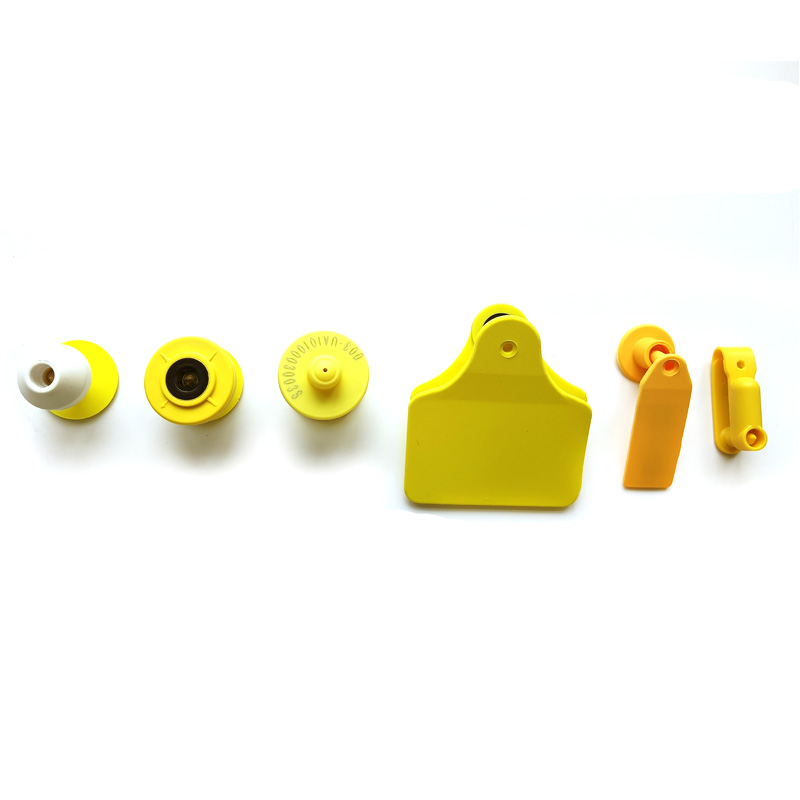
Low Frequency RFID tags are commonly built for rugged and long-term use. Because LF is widely used in animal identification and industrial environments, tags are often encapsulated in durable materials such as glass, epoxy, or thick plastic housings. Injectable glass capsule tags are sealed to protect the chip and coil from moisture and mechanical stress. Livestock ear tags use reinforced plastic casings designed to withstand outdoor exposure, impact, and temperature variation. Automotive immobilizer transponders are also molded into solid protective shells. The construction priority in LF systems is environmental resistance and mechanical stability rather than thinness or flexibility.
High Frequency RFID tags are available in a broader range of physical formats, especially in thin and flexible constructions. Common formats include PVC smart cards, paper-based labels, adhesive NFC stickers, and dry or wet inlays designed for lamination. Because HF antennas can be etched or printed on flat substrates, the tags can be very thin and integrated into tickets, packaging, books, or ID cards. While rugged HF versions do exist for industrial use, many HF deployments prioritize compact size, low profile, and ease of integration into consumer-facing products.
12. System Architecture
Low Frequency RFID systems are typically built around simple point-to-point identification. In many deployments, a single reader interacts with one tag at a time, retrieves a fixed ID number, and passes that ID to a controller or backend database for processing. The tag itself usually stores minimal data, so most information management happens in the central system. Network integration is often straightforward, with readers connected via serial, USB, or simple industrial interfaces.
High Frequency RFID systems tend to support more layered and feature-rich architectures. Because HF supports anti-collision, higher data rates, and structured memory, the interaction between reader and tag can involve authentication steps, encrypted exchanges, and block-level data operations. In access control or payment systems, the tag may store application data, security keys, or transaction records, which shifts part of the logic closer to the tag itself. HF readers often integrate with networked systems, middleware platforms, and centralized management software that handle credential management, logging, and security policy enforcement.
13. System Cost Structure
The overall system cost structure includes not only the tag price, but also reader cost, infrastructure requirements, and long-term operational expenses.
Low Frequency RFID systems often have relatively low complexity, which can translate into predictable and stable cost structures. LF tags, especially simple read-only versions, are typically inexpensive, though rugged industrial or animal ear tags may cost more due to durable housing materials. LF readers are generally straightforward in design and may be lower in protocol licensing or certification requirements. Because LF systems are usually ID-based and backend-driven, software integration is often simpler. In applications like livestock identification or basic access control, the total system cost is largely influenced by tag durability and reader deployment scale rather than advanced software infrastructure.
High Frequency RFID systems can vary more widely in cost depending on application requirements. Basic HF labels or NFC tags can be very inexpensive in high volume production, especially in consumer or ticketing environments. However, smart cards with secure elements, encryption capabilities, or larger memory capacities cost more per unit. HF readers may also be more complex, particularly when supporting ISO-14443 secure authentication, encryption modules, or multi-protocol operation. In addition, systems involving credential management, encryption key handling, and middleware platforms can increase software and integration costs. Certification and compliance requirements may also add to total deployment expenses in regulated industries.
14. Applications
Because of the technical characteristics described above, LF and HF RFID are typically used in different application environments.
Low Frequency RFID is commonly used in applications where short-range, one-tag-at-a-time identification is acceptable and the environment may include water, biological tissue, dirt, or nearby metal. LF systems are often chosen when durability and stable reads matter more than speed or data-rich interaction.
Typical Low Frequency RFID applications include:
- Animal identification and livestock management
- Pet microchipping and veterinary tracking
- Automotive immobilizer and vehicle security systems
- Basic access control in industrial or legacy setups
- Rugged asset identification in harsh environments
High Frequency RFID is used across a wider variety of standardized systems because 13.56-MHz supports global protocols, stronger anti-collision performance, and higher data rates. HF is often selected when multi-tag handling, structured memory, or interoperability is required.
Typical High Frequency RFID applications include:
- Access control systems using smart cards
- Library and media circulation tracking
- Public transportation ticketing and fare systems
- Contactless payments and mobile wallet ecosystems
- Authentication and identity credentials
- NFC-based marketing, product interaction, and device pairing
Should You Consider Ultra-High Frequency RFID Instead?
After comparing LF and HF RFID, it is natural to ask whether Ultra High Frequency RFID might be a better option for certain systems.
The answer depends primarily on required read distance, reading speed, and deployment scale.
UHF RFID typically operates in the 860 to 960 MHz range and uses far-field electromagnetic coupling rather than magnetic inductive coupling. This allows significantly longer read distances. Passive UHF tags commonly achieve read ranges of 3 to 10 meters under normal conditions, and optimized fixed-reader systems can exceed 10 meters. UHF also supports fast inventory scanning and strong anti-collision performance, allowing hundreds of tags to be read within seconds in portal or warehouse environments.
However, UHF is more sensitive to environmental conditions than LF and HF. Water and high moisture content can absorb UHF signals, reducing read reliability. Metal surfaces can reflect or detune signals unless specialized on-metal tags are used. System tuning, antenna placement, and environmental testing are therefore more critical in UHF deployments.
From a cost structure perspective, basic UHF labels can be very inexpensive in high volumes, often comparable to or lower than HF labels. However, UHF readers and antennas are generally more expensive than LF or HF reader modules, especially for fixed industrial installations. Deployment planning is also more complex due to longer read zones and signal propagation behavior.
Therefore, you should consider UHF if your application requires meter-level read distance, rapid multi-tag scanning, or warehouse-scale asset tracking. If your system operates at close range, requires high environmental tolerance near water or biological tissue, or needs secure smart-card functionality, LF or HF may remain more appropriate.